Service Generator: Applying Urban Building Energy Services (UBES)
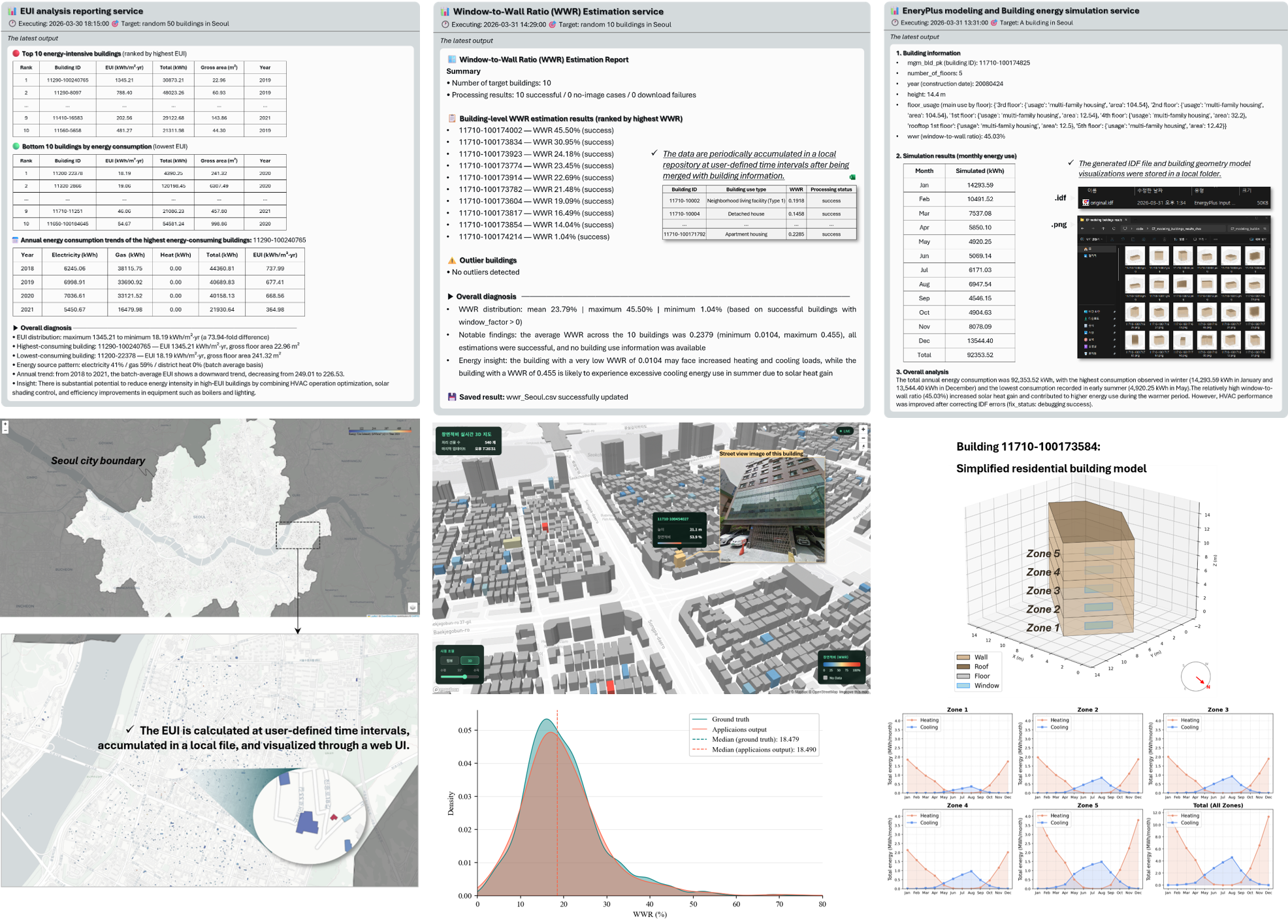
Three representative services — EUI monitoring, window-to-wall ratio (WWR) estimation, and EnergyPlus-based energy simulation — were implemented using real building data from Seoul, corresponding to the three core UBEM task types of monitoring, feature engineering, and simulation (Fig. 1). Although the three services differ in data types, execution procedures, and output formats, all were generated within the same framework, demonstrating its ability to handle heterogeneous service requirements. The EUI monitoring service computed annual energy use intensity for 85,646 buildings in Seoul; the WWR estimation service automatically estimated window-to-wall ratios from facade images using YOLO-based object detection; and the EnergyPlus simulation service automatically generated IDF files from building registry data and performed annual energy simulations. These results demonstrate that the proposed UBES generation framework is not limited to a single service type, but can configure diverse urban building energy analyses as executable service units.
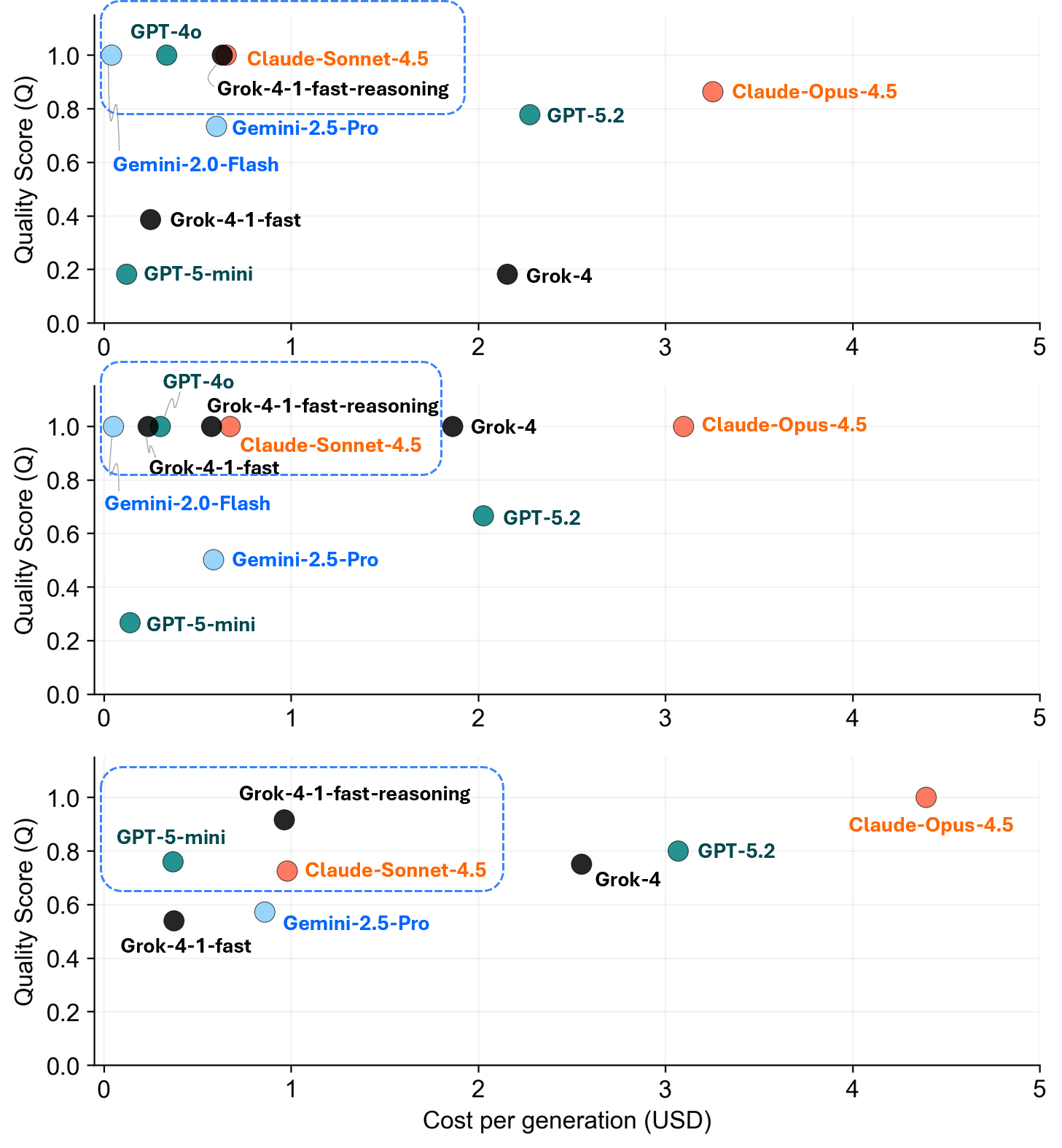
A service generation experiment was conducted across three service types using 12 LLMs, and the results reveal that the relationship between model tier and generation quality is not straightforward (Fig. 2). Lightweight models frequently failed to generate valid DAG structures for complex services, although they performed adequately for simpler ones. Strongest-tier models, while capable of handling complex services, tended to over-engineer simple services by generating unnecessarily complex workflows, which can increase execution time and cost and may lead to service execution failures. By contrast, balanced-tier models such as Claude-Sonnet-4.5 and Grok-4-1-fast-reasoning achieved generation quality comparable to that of the strongest models at substantially lower token consumption and generation cost. These findings suggest that selecting the highest-performing model is not always the optimal strategy in agentic service generation; rather, matching model tier to service complexity offers a more cost-effective approach to deployment.