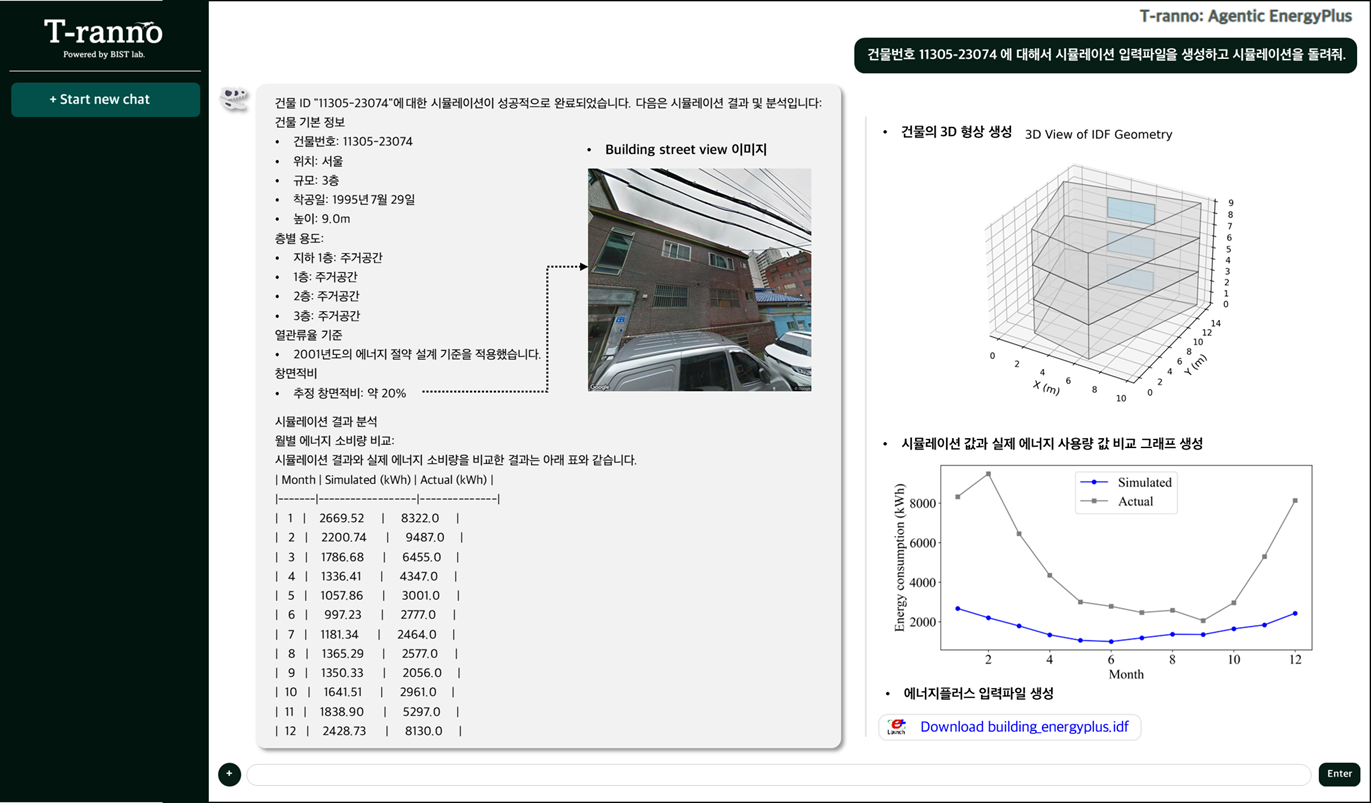
Agentic Building Energy Modeling
Building Energy Modeling (BEM) is a simulation technique used to predict and analyze a building's energy consumption. It quantitatively models various energy components—such as heating, cooling, lighting, and ventilation—on a time-dependent basis. These models are widely applied for purposes such as energy performance assessment, retrofit simulations, and carbon emission analysis.
However, conventional approaches to energy modeling present several limitations. Simulation engines like EnergyPlus require a detailed input data file (IDF: Input Data File), which must include complex information such as building geometry, material properties, internal loads, and system configurations. Creating these input files manually or using commercial tools like DesignBuilder demands a high level of expertise and incurs significant time and cost. These challenges are further amplified when modeling buildings at the urban scale, making traditional methods inefficient and lacking scalability.
Against this backdrop, the present study proposes Agentic Building Energy Modeling, an automated building energy modeling framework powered by AI agents. This approach leverages Large Language Models (LLMs) in conjunction with expert knowledge-based agents to overcome the limitations of manual or semi-automated workflows. The agent transforms unstructured building-related data into structured simulation-ready IDF files.
Previous studies have employed fine-tuning of LLMs for generating IDF files. However, such methods require large domain-specific datasets, extensive computational resources, and significant time investment, while offering limited scalability to new building types or cities. Recent advances in LLMs now enable system-level implementations through knowledge engineering rather than fine-tuning. In response, this study designs an AI agent framework grounded in expert knowledge to perform automated, expert-level building energy modeling.
The proposed framework integrates multiple types of data. For instance, GIS data provides geometric information used to construct polygonal building envelopes; administrative data contributes attributes such as building use type, floor area, number of stories, and construction year, which are essential for generating IDF objects. Furthermore, street view images are analyzed to estimate the window-to-wall ratio, improving the fidelity of the building envelope modeling.
To successfully perform such multifaceted tasks, the agent must incorporate expert-level engineering logic and a rule-based knowledge system. This study implements a refined knowledge engineering process that enables the generation of meaningful IDF objects for each building and constructs an automated simulation pipeline suitable for city-scale modeling.
본 서비스는 https://bist.t-ranno.com/energyplus 에서 제공되고 있으며, 아래는 서비스 시연 영상이다.