Developing a Database Automation Agent
A Database automation agent is an AI-driven software agent that automatically discovers, collects, organizes, and updates structured data from external sources with minimal human intervention. Instead of relying on manual searching and repetitive data handling, it can interpret a user’s request, identify relevant websites or APIs, retrieve the necessary information, and transform it into a database-ready format. In practical terms, this kind of agent acts like a digital operator for data pipelines: it searches public portals, reads documentation, detects downloadable files or API endpoints, extracts required parameters, and generates the logic needed to build or refresh a database. Its value is especially high in environments where data sources are diverse, frequently updated, and difficult to manage manually. By automating these steps, a Database Automation Agent reduces labor costs, shortens data acquisition time, and improves the consistency and scalability of data collection. It can also support decision-making by ensuring that the latest external information is continuously reflected in the database.
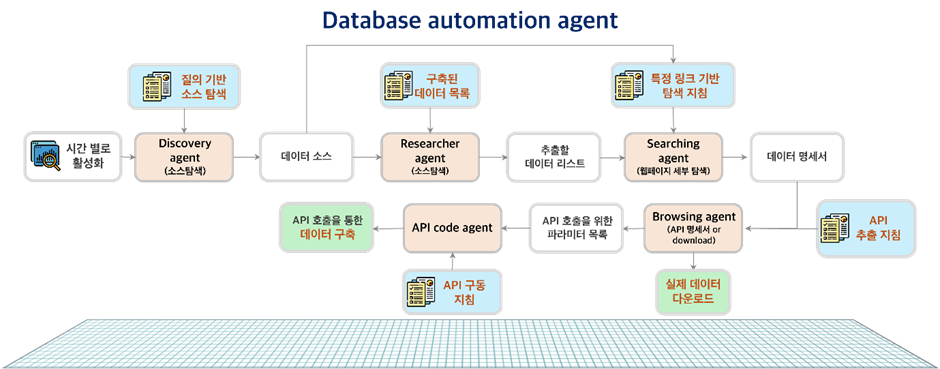
In a broader AI workflow, a Database Automation Agent often works as part of a multi-agent system. One agent may first discover relevant sources, another may evaluate which data is useful, and another may navigate websites or APIs to download actual datasets. The Database Automation Agent connects these processes and turns fragmented web information into a structured, reusable database. This makes it highly suitable for research and business applications such as urban analytics, policy evaluation, event impact analysis, and automated monitoring systems. For example, it can gather public transportation data, environmental indicators, or local government statistics, then store them in a form ready for analysis. However, full automation still has practical limits, such as API key issuance, login barriers, CAPTCHA, and changing website structures. Therefore, the most realistic model is a semi-automated system in which the agent performs most of the repetitive technical work while humans review sensitive steps and validate final outputs.