BISTProjects프로젝트

Research Project BIST

Agentic Virtual Commissioning

AI-agent-based automation of PID parameter virtual commissioning for building HVAC systems AI 에이전트 기반 건물 HVAC 시스템의 PID 파라미터 가상 시운전 자동화

Control-fault diagnosis, digital twin (DT) construction, Bayesian MH-MCMC PID candidate estimation and independent validation are linked into one procedure, and the recommended PID is presented for engineer review. 제어 이상 진단, 디지털 트윈(DT) 구축, Bayesian MH-MCMC 기반 PID 후보 추정과 독립 검증을 하나의 절차로 연계하고, 추천 PID를 엔지니어 검토안으로 제시한다.

Research overview연구 개요

Illustration: a night city on the Earth (physical buildings and HVAC systems), its digital twin shown as a blue hologram on a glass plate (virtual buildings), and an AI agent on the Building Operating System slab above, ringed by its five roles: diagnosis, DT engineering, PID search, validation and recommendation, with schematic holographic operating panels around it (operating status, loop monitor, PID search).그림: 지구 위 야간 도시(물리 건물 · HVAC 설비), 유리판 위 푸른 홀로그램으로 표현한 그 디지털 트윈(가상 건물), 그 위 Building Operating System 판의 AI 에이전트와 다섯 역할(이상 진단, DT 구축, PID 탐색, 독립 검증, 검토안 추천)의 링, 에이전트 주변의 개념적 홀로그램 운영 패널(운영 상태, 루프 모니터, PID 탐색).

01Background and objective연구 배경 및 목적

Need for automated PID virtual commissioning PID 파라미터 가상 시운전 자동화의 필요성

PID parameters set at commissioning are rarely re-tuned in operation. As outdoor conditions, loads and schedules change, the fixed settings can degrade control performance, seen as hunting and repeated actuator operation. PID 파라미터는 시운전 단계에서 설정된 뒤 운영 중에는 재조정 없이 고정값으로 쓰이는 경우가 많다. 외기 · 부하 · 운영 스케줄이 바뀌면 초기 설정은 헌팅과 액추에이터 반복 구동 같은 제어성능 저하로 이어질 수 있다.

  1. Measured실측HST · 2020-03-27

    BAS measurement with the existing PID from 12:00: the heating supply temperature oscillates between about 43.8 and 46.5 °C around the 45 °C set-point, with a period of about 6 minutes.기존 PID 운전 BAS 실측(12:00부터): 난방공급온도가 설정값 45 °C를 중심으로 약 43.8~46.5 °C 사이에서 약 6분 주기로 진동한다.

    Problem문제

    Fixed PID parameters고정된 PID 파라미터

    Settings from commissioning stay fixed as conditions change, which can lead to hunting.시운전 때 설정된 값이 운전조건이 바뀐 뒤에도 유지되어 헌팅으로 이어질 수 있다.

  2. Constraint제약

    Risk of field re-tuning현장 재조정의 위험

    Trial tuning on an operating plant risks control instability and degraded thermal service.운영 중인 설비에서 시행착오로 조정하면 제어가 불안정해지고 열적 서비스 품질이 떨어질 수 있다.

  3. Alternative대안

    DT-based virtual commissioningDT 기반 가상 시운전

    PID candidates are evaluated in closed-loop simulation without touching the plant.실제 설비에 영향을 주지 않고 PID 후보의 폐루프 응답과 성능을 평가할 수 있다.

  4. Limitation한계

    Engineering repeated per loop제어루프별 반복 엔지니어링

    Models and test conditions must be prepared by hand for every building and loop.건물 · 제어루프마다 모델 준비와 시운전 조건 설정을 수작업으로 반복해야 한다.

Objective연구 목적

AVC integrates and automates the PID parameter virtual commissioning procedure with AI agents.AVC는 AI 에이전트를 활용하여 PID 파라미터 가상 시운전 절차를 통합 · 자동화한다.

The control performance and actuator behaviour of the derived PID candidates are evaluated on a DT to support the engineer’s review for field application.도출된 PID 후보의 제어성능과 액추에이터 거동을 DT에서 평가하여 엔지니어의 현장 적용 검토를 지원한다.

AI-agent-based virtual commissioning serviceAI 에이전트 기반 가상 시운전 서비스

  1. FDD

    Control-fault detection & diagnosis제어 이상 탐지 · 진단

    A1

  2. DT Simulator

    Closed-loop dynamic reproduction폐루프 동적 응답 재현

    A2

  3. PID Exploration

    Bayesian MH-MCMC candidate estimationBayesian MH-MCMC 후보군 추정

    A3

  4. Validation

    Existing vs recommended PID기존 · 추천 PID 비교

    A4

  5. Recommendation

    Review plan for field application현장 적용 검토안

    Output산출

02Framework프레임워크

AVC architecture and virtual commissioning workflow AVC 아키텍처와 가상 시운전 워크플로우

An orchestrator plans and manages the procedure; four specialist agents set the run conditions of each stage and evaluate its results. Computation runs in the engineering tools, and the ontology and expert rules constrain agent decisions. In the prototype, these roles are implemented with rules and engineering tools. 오케스트레이터가 전체 절차를 계획 · 관리하고, 4개 전문 에이전트가 단계별 실행 조건을 결정하고 결과를 평가한다. 연산은 엔지니어링 도구에서 수행되며, 온톨로지와 전문가 규칙이 에이전트 판단을 제약한다. 프로토타입에서는 이 역할을 규칙과 엔지니어링 도구로 구현하였다.

Orchestrator

Plan · coordinate · re-plan계획 · 조정 · 재계획

  • Execution planning수행 계획 관리
  • Agent coordination에이전트 역할 조정
  • Run status & results실행 상태 · 결과 관리
  • Verification-based re-planning검증 기반 재계획

Specialist agents전문 에이전트decide run conditions · evaluate results실행 조건 결정 · 결과 평가

Decisions constrained by ontology & expert rules온톨로지 · 전문가 규칙 기반 판단 제약

Engineering tools엔지니어링 도구compute · simulate계산 · 시뮬레이션 실행

Ontology Query · FDD

Model Training

Bayesian MH-MCMC

Performance Evaluation

BAS operating dataBAS 운전 데이터

DT Simulatorcomponent-model closed loop컴포넌트 모델 기반 폐루프

Ontology & domain knowledge온톨로지 · 도메인 지식

Shared knowledge · decision constraints공통 지식 · 판단 제약

Ontology온톨로지

A knowledge model that defines the relations among building objects such as equipment, sensors and controllers.건물의 설비 · 센서 · 제어기 등 객체 간 관계를 의미론적으로 정의한 지식체계

Expert rules전문가 규칙

  • Model-variable selection constraints모델 변수 선정 제약
  • Allowable PID rangePID 파라미터 허용 범위
  • Model and commissioning validation criteria모델 · 시운전 검증 기준
Point at an agent to trace its tools and knowledge.에이전트를 가리키면 연결된 도구와 지식이 강조된다.Tap an agent to trace its tools and knowledge.에이전트를 탭하면 연결된 도구와 지식이 강조된다.

B

PID virtual commissioning workflowPID 가상 시운전 워크플로우

Two verification gates check DT reproducibility and the acceptance criteria. If a gate fails, the run is re-planned to DT reconfiguration or PID re-search, depending on the cause.DT 재현성과 추천 수용 기준의 두 검증 게이트에서 기준에 미달하면, 원인에 따라 DT 재구성 또는 PID 재탐색으로 재계획한다.

Planagent decision에이전트 판단

Executetool execution도구 실행

Evaluateverification gate검증 게이트

Re-planreturn path반환 경로

1Trigger & Scoping

PlanA1
  • Trigger · fault diagnosis트리거 수신 · 이상 진단
  • Target loop · analysis period대상 루프 · 기간 선정
ExecuteOntologyFDD
EvaluateCommissioning target confirmed시운전 대상 확정

2DT Engineering

PlanA2
  • Variables · training / calibration변수 · 학습/보정 조건
  • Component models컴포넌트 모델 구성
ExecuteTrainingDT constructionDT 구축
EvaluateReproducible?재현성 확보?

Insufficient → revisit DT configuration, training and calibration미흡 → DT 구성 · 학습 · 보정 재검토

3PID Commissioning

PlanA3
  • Search range · initial condition탐색 범위 · 초기조건
  • MCMC settings (τ, chains, iterations)MCMC 설정 (τ · 체인 · 반복 수)
ExecuteMH-MCMC × DT
EvaluatePID candidate set estimatedPID 후보군 추정

4Validation & Decision

PlanA4
  • Validation period · scenarios검증 기간 · 시나리오
  • Acceptance criteria추천 수용 판단 기준
ExecuteIndependent validation독립 검증기간 비교Virtual set-point change가상 설정값 변화 시나리오
EvaluateCriteria met?기준 충족?

Candidate / search-condition issue → PID re-search후보 · 탐색 조건 문제 → PID 재탐색DT reliability issue → DT reconfigurationDT 신뢰성 문제 → DT 재구성

5Recommendation

Output산출
  • Recommended PID candidate추천 PID 후보
  • Quantitative control performance정량적 제어성능
  • Application conditions · review notes적용 조건 · 검토안
DT validation resultsDT 가상 검증 결과
Engineer review for field application엔지니어 현장 적용 검토
Candidate / search-condition issue → PID re-search후보 · 탐색 조건 문제 → PID 재탐색 DT reliability / reproducibility issue → DT reconfigurationDT 신뢰성 · 재현성 미흡 → DT 재구성

03Method방법

DT closed-loop simulation and Bayesian PID search DT 폐루프 시뮬레이션과 베이지안 PID 탐색

The DT simulator links component models into a closed loop and computes it step by step. The MH-MCMC search simulates every PID candidate on this loop before accepting or rejecting it. DT 시뮬레이터는 컴포넌트 모델을 폐루프로 연계해 시점별로 순차 계산하고, MH-MCMC 탐색은 모든 PID 후보를 이 폐루프에서 시뮬레이션한 뒤 수락 · 기각한다.

A

DTSimulator시뮬레이터

Component-model-based closed-loop dynamic reproduction컴포넌트 모델 기반 폐루프 동적 재현

At every one-minute step the PID controller, the temperature control valve (TCV) model and the plant model are computed in turn; the simulated heating supply temperature (HST) returns through a one-step sensor delay.1분 간격의 각 시점에서 PID 제어기, 온도조절밸브(TCV) 모델, 플랜트 모델을 차례로 계산하고, 계산된 난방공급온도(HST)를 한 시점 지연된 센서값으로 되먹임한다.

Set-point설정값 r(k)
–°C
Control error제어오차 e(k)
–°C
TCV openingTCV 개도 v(k)
–%
Plant response · HST플랜트 응답 · HST y(k)
–°C

Replay of the DT closed-loop simulation with the existing PID (Kp 2.90, Ki 1.60), 2020-03-27 12:02–12:25, repeated. r(k) is the recorded set-point; v(k) and y(k) are DT outputs. The plant model responds with a one-minute lag, so y(k) follows from v(k−1).기존 PID(Kp 2.90, Ki 1.60) 조건의 DT 폐루프 시뮬레이션 재생(2020-03-27 12:02~12:25 반복). r(k)는 기록된 설정값, v(k)·y(k)는 DT 출력값이다. 플랜트 모델은 1분 지연으로 응답하므로 y(k)는 v(k−1)의 결과이다.

Reproducibility before the PID searchPID 탐색 전 재현성 평가existing PID vs BAS data · 7 days × 6 h, median기존 PID 실측 대비 · 7일 × 6시간 · 중앙값

HST MAE
0.809°C
TCV opening MAETCV 개도 MAE
3.45%p

B

Recorded run실행 기록Bayesian MH-MCMC

PID candidate-set estimation in the Kp–Ki spaceKp–Ki 공간의 PID 후보군 추정

Eight chains propose 75 candidates θ = (Kp, Ki) each; the D term is not used. Every candidate is simulated on the DT and accepted or rejected by the Metropolis–Hastings rule on J(θ), an objective based on HST set-point tracking.8개 체인이 각각 75회 후보 θ = (Kp, Ki)를 제안한다(D항 미사용). 각 후보를 DT에서 시뮬레이션하고, HST 설정값 추종성능 기반 목적함수 J(θ)에 Metropolis–Hastings 규칙을 적용해 수락 또는 기각한다.

Proposals후보 제안
600/ 600
Accepted수락
148
Evaluated by DTDT 평가 후보
588incl. existing PID기존 PID 포함
  • Recommended candidate추천 후보Kp 0.30 · Ki 0.61
  • Existing PID기존 PIDKp 2.90 · Ki 1.60
  • High-density region고밀도 영역posterior-like density, J-weighted (τ 0.15)posterior-like 밀도, J 가중(τ 0.15)
  • Accepted proposal수락된 제안
  • Rejected proposal기각된 제안
  1. 1Propose후보 제안 θ = (Kp, Ki)
  2. 2DT closed-loop simulationDT 폐루프 시뮬레이션
  3. 3Evaluate평가 J(θ)HST set-point trackingHST 설정값 추종성능
  4. 4Accept / reject수락 · 기각MH

Session data (2020-03-25 – 29), replayed time-compressed — not a schematic; the density field and its dashed display contour are shown once the run ends. The candidate with the lowest J among all evaluated candidates, inside the high-density region, goes to A4; TCV travel and repeated actuation are evaluated separately in the independent validation.세션 기록(2020-03-25~29)을 시간 압축해 재생한 것으로, 개념도가 아니다. 밀도 분포와 점선 표시 등고선은 실행이 끝난 뒤 나타난다. 평가 후보 중 J가 가장 작은 후보(고밀도 영역 안)를 A4에 전달하며, TCV 이동량과 반복 구동은 독립 검증에서 별도로 평가한다.

04Application and results적용 및 결과

Case study of a high-zone heating supply temperature (HST) control loop 고층부 난방공급온도(HST) 제어루프 적용 사례

A PID controller sets the opening of the primary temperature control valve (TCV) to track an outdoor-reset HST set-point. The abnormal behaviour was diagnosed from building automation system (BAS) data, reproduced on the DT, and the recommended PID was validated on the DT over a period not used in the search. PID 제어기가 외기보상 HST 설정값을 추종하도록 1차측 온도조절밸브(TCV) 개도를 조절하는 루프이다. 이상 거동을 BAS 실측으로 진단하고 DT로 재현한 뒤, 추천 PID를 탐색에 쓰지 않은 기간에 대해 DT에서 독립 검증하였다.

Site대상 단지
Mixed-use complex, Goyang-si, Gyeonggi-do · district heating경기도 고양시 주상복합 · 지역난방
System대상 계통
High-zone heat-exchanger train, 7 towers7개 동 고층부 공급 열교환기 계통
Control loop제어루프
HST (secondary) · primary TCV · outdoor resetHST(2차측) · 1차측 TCV · 외기보상 설정값
Request period요청 기간
2020-03-25 – 31 · 12:00–18:002020-03-25~31 · 12:00~18:00
  1. 1BASMeasurement · existing PID실측 · 기존 PID

    HST hunting and repeated TCV actuation under the existing PID기존 PID 조건의 HST 헌팅과 TCV 반복 구동

    • Measured (existing PID)실측 (기존 PID)Kp 2.90 · Ki 1.60
    • Set-point설정값

    Representative day대표일 2020-03-27

    Control-fault diagnosis제어 이상 진단

    FDD and loop analysis, 2020-03-25 – 31; period, travel and reversals are 7-day medians.FDD · 제어루프 분석(2020-03-25~31). 주기 · 이동량 · 방향 반전은 7일 중앙값.

    flagged by FDDFDD 이상 판정
    7 / 7days일
    hunting period, same for HST and TCV헌팅 주기 · HST와 TCV 동일 주기
    ≈6min분
    cumulative TCV travelTCV 누적 이동량
    167%p/h
    TCV direction reversalsTCV 방향 반전
    ≈21/h
  2. 2DTReproduction · existing PID재현 · 기존 PID

    Dynamic reproduction of the feedback control loop: measured vs DT피드백 제어루프의 동적 재현: 실측 대 DT

    • Measured (BAS)실측 (BAS)
    • Simulated (DT)시뮬레이션 (DT)
    • Set-point설정값

    2020-03-27 · Kp 2.90 · Ki 1.60

    Reproduction accuracy재현 정확도

    2020-03-27, 12:00–18:002020-03-27, 12:00~18:00

    HSTMAE · RMSEMAE · RMSE
    0.647°C
    RMSE 0.843 °C
    TCV openingTCV 개도MAE · RMSEMAE · RMSE
    2.80%p
    RMSE 3.67 %p
    Oscillation amplitude진동 진폭SD ratio, DT / measured표준편차 비, DT / 실측
    1.00
    HST 1.000 · TCV 1.001

    7-day median (2020-03-25 – 31): HST MAE 0.809 °C · TCV MAE 3.45 %p · SD ratio 1.07 / 1.057일 중앙값(2020-03-25~31): HST MAE 0.809 °C · TCV MAE 3.45 %p · 표준편차 비 1.07 / 1.05

    The DT simulates the loop in closed loop from the 12:00 initial state with the same existing PID; after initialisation its controller acts on the simulated HST, not on the measurement. The hunting amplitude and period (≈ 6 min) of the measured loop are reproduced, which is the basis for comparing PID candidates on the DT.DT는 12:00 초기 상태에서 동일한 기존 PID로 폐루프를 계산하며, 초기화 이후 제어기는 실측값이 아니라 DT가 계산한 HST에 반응한다. 실측 루프의 헌팅 진폭과 주기(약 6분)가 재현되며, 이것이 DT에서 PID 후보를 비교하는 근거이다.

    Daily accuracy, 7 days일별 정확도 (7일)
  3. 3DTPID searchPID 탐색

    600 MH-MCMC proposals (587 distinct) and the existing PID, 588 gain pairs in all, were simulated on this DT; the recommended candidate is Kp 0.30, Ki 0.61.이 DT에서 MH-MCMC 후보 제안 600회(중복 제외 587개)와 기존 PID, 총 588개 이득 조합을 시뮬레이션하였고, 추천 후보는 Kp 0.30, Ki 0.61이다.

    Search run탐색 기록
  4. 4DTSimulation · independent validation시뮬레이션 · 독립 검증

    HST and TCV responses in the independent validation period독립 검증기간의 HST · TCV 제어응답

    • Set-point설정값

    Change vs existing PID기존 PID 대비 변화율

    2020-03-30 – 31 · 2-day mean · DT independent validation, not field data2020-03-30~31 · 2일 평균 · DT 독립 검증 (현장 실측 아님)

    HST set-point tracking MAEHST 설정값 추종 MAEtracking error추종 오차
    −93.1%
    0.715→0.049 °C
    HST control oscillation RMSHST 제어 진동 RMShunting intensity헌팅 강도
    −92.9%
    0.737→0.053 °C
    TCV total travelTCV 총 이동량valve travel, 12:00–18:00밸브 이동량 (12:00~18:00)
    −96.8%
    1,128.5→35.6 %p

    Both controllers were simulated under identical DT conditions for 2020-03-30 – 31, a period not used in the search. Oscillation RMS is the RMS deviation of HST from its 15-min moving average. TCV direction reversals (0.5 %p deadband) fell from 130 to 0 per 6 h.두 제어기 모두 탐색에 쓰지 않은 2020-03-30~31에 대해 동일한 DT 조건으로 시뮬레이션하였다. 진동 RMS는 HST와 15분 이동평균의 차이에 대한 RMS이다. TCV 방향 반전(0.5 %p 불감대 기준)은 6시간당 130회에서 0회로 감소하였다.

    View as table표로 보기
  5. 5DTSimulation · virtual scenario시뮬레이션 · 가상 시나리오

    Virtual +1 °C set-point change at 14:0014:00 가상 설정값 +1 °C 변화 시험

    • Existing PID기존 PID
    • Recommended PID추천 PID
    • Set-point설정값

    Existing → recommended PID기존 PID → 추천 PID

    2-day mean · DT simulation2일 평균 · DT 시뮬레이션

    Overshoot오버슈트
    0.96→0.01°C
    IAE60 min after the change변경 후 60분
    37.0→13.5°C·min
    Oscillation RMS진동 RMSafter the change, 14:00–18:00변경 후 (14:00~18:00)
    0.554→0.063°C

    The set-point was raised by 1 °C at 14:00 on each validation day and both controllers were simulated on the DT; values are 2-day means. IAE and overshoot cover 14:00–15:00; oscillation RMS covers 14:00–18:00.각 검증일 14:00에 설정값을 1 °C 높이고 두 제어기를 DT에서 시뮬레이션하였다. 수치는 2일 평균이다. IAE와 오버슈트는 14:00~15:00, 진동 RMS는 14:00~18:00 기준이다.

    View as table표로 보기

Recommendation · for engineer review추천안 · 엔지니어 검토용

Recommended PID parameters추천 PID 파라미터

Derived from 588 gain pairs evaluated by DT closed-loop simulation over the search period 2020-03-25 – 29 (600 MH-MCMC proposals and the existing PID).탐색 기간(2020-03-25~29)에 DT 폐루프 시뮬레이션으로 평가한 588개 이득 조합(MH-MCMC 후보 제안 600회와 기존 PID)으로부터 도출하였다.

Existing and recommended PID gains기존 및 추천 PID 이득
Existing기존Recommended추천
Kp2.900.30
Ki1.600.61

Engineering implications공학적 시사점DT-based · before field verificationDT 결과 기반 · 현장 검증 전

  • Reduced HST hunting indicates a potential to stabilise thermal service quality.HST 헌팅 감소는 열적 서비스 품질 안정화 가능성을 시사한다.
  • Reduced repeated TCV actuation indicates a potential to lower mechanical wear and maintenance burden.TCV 반복 구동 감소는 기계적 마모 저감과 유지관리 부담 완화 가능성을 시사한다.

Scope of validation검증 범위

Apart from the BAS measurements (2020-03-25 – 31), every result in this section is an offline DT simulation; the validation period (2020-03-30 – 31) was not used in the search. The recommended PID was not connected to an actual controller or applied to the field BAS; field application and control-performance verification in the heating season are planned. The DT was trained on data under the existing PID, so responses at other gains, including the recommended one, involve extrapolation.BAS 실측(2020-03-25~31)을 제외한 이 절의 결과는 모두 오프라인 DT 시뮬레이션이며, 검증기간(2020-03-30~31)은 탐색에 쓰지 않았다. 추천 PID는 실제 제어기에 연계하거나 현장 BAS에 적용하지 않았으며, 동절기 현장 적용과 제어성능 검증을 향후 수행할 계획이다. DT는 기존 PID 운전 데이터로 학습되었으므로, 추천 PID를 포함한 다른 이득의 응답은 학습 범위 밖 외삽을 포함한다.

05Demonstration시연

AVC prototype demonstrationAVC 프로토타입 시연

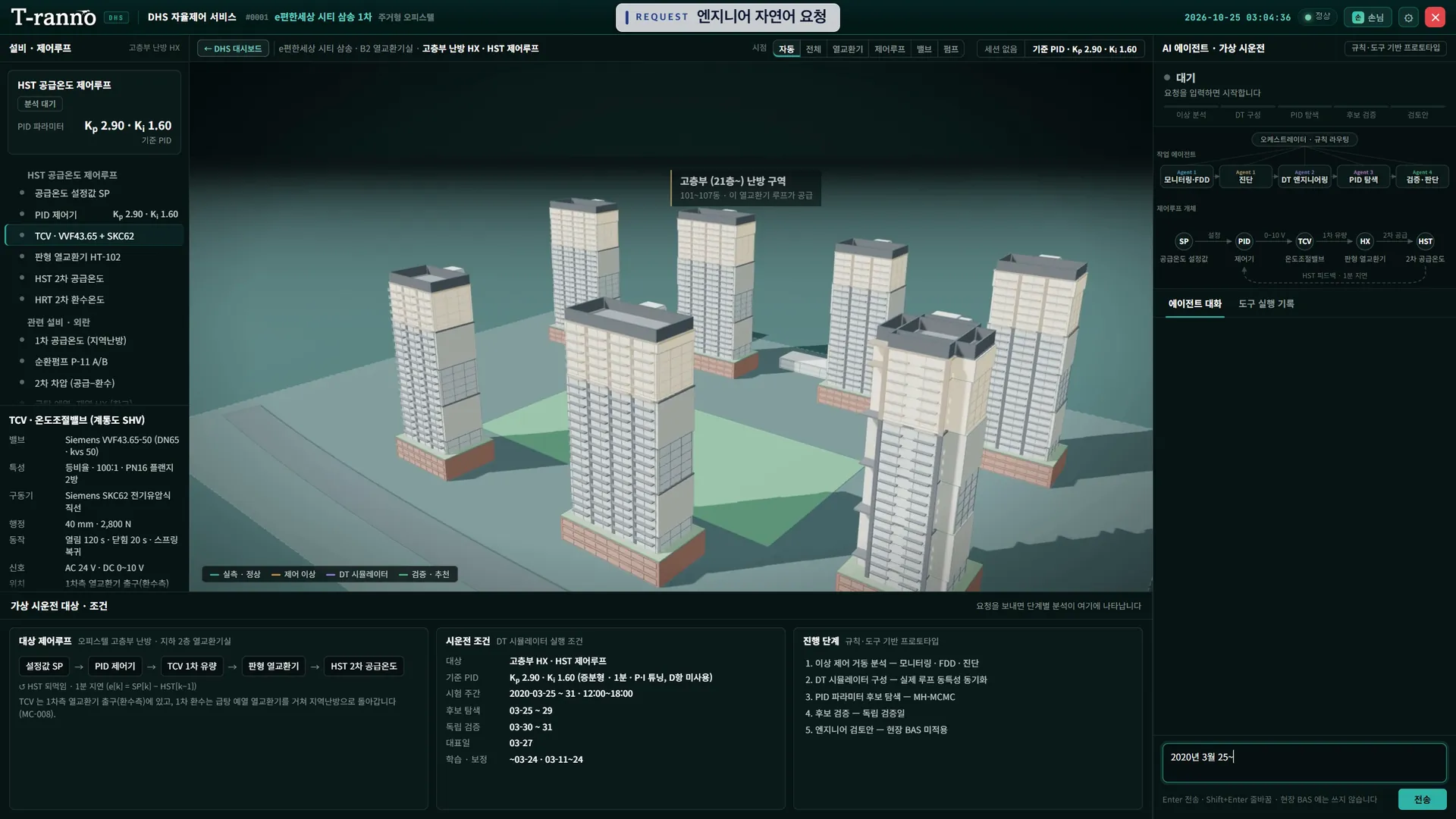
A recorded run of the AVC prototype, from the engineer’s request to the engineering review. Candidate evaluation and validation ran on the DT; no control command was sent to the field BAS. 엔지니어의 요청부터 엔지니어링 검토안까지, AVC 프로토타입의 실행 과정을 기록한 영상이다. PID 후보의 평가와 검증은 DT에서 수행하였으며, 현장 BAS에는 제어 명령을 보내지 않았다.

Soundtrack: “Vastness”, Andrew Ev (Mixkit)음악: “Vastness”, Andrew Ev (Mixkit)

Demonstration scope시연 범위

The recommendation is presented for engineer review and was not applied to the field BAS. The run was recorded with the rule- and tool-based prototype.추천안은 엔지니어 검토용으로 제시되며 현장 BAS에는 적용하지 않았다. 시연은 규칙 · 도구 기반 프로토타입으로 기록하였다.

06Future direction향후 연구 방향

From building automation to
autonomous building operations
건물 자동제어에서
건물 자율 운영으로

  1. 01

    Physical Buildings & HVAC Systems

    The physical layer of buildings, HVAC equipment and sensors through which thermal services are delivered.열적 서비스가 제공되는 건물, HVAC 설비, 센서로 이루어진 물리 계층이다.

  2. 02

    BAS / BEMS

    The current automation layer for real-time control, monitoring and operating data, and the data source of the DT.실시간 제어 · 모니터링 · 운전 데이터를 담당하는 현재의 자동제어 계층이며, DT 구축의 데이터원이다.

  3. 03

    Building Operating System Future vision미래 비전

    The Building Operating System (BOS) is envisioned as an operating layer above BAS/BEMS that plans, executes, validates and improves operation through Planning → Virtual Commissioning → Validation → Operation.Building Operating System(BOS)은 BAS/BEMS 위에서 운영을 계획 · 실행 · 검증 · 개선하는 운영 계층으로 구상하고 있으며, Planning → Virtual Commissioning → Validation → Operation의 순환을 따른다.

  4. 04

    AVC → CVC → Autonomous Building Operations

    AVC (this study) automates PID parameter virtual commissioning with AI agents. The planned next step is Continuous Virtual Commissioning (CVC) on the BOS, with Autonomous Building Operations as the long-term goal.AVC(본 연구)는 PID 파라미터 가상 시운전을 AI 에이전트로 자동화한다. 다음 단계로 BOS 기반의 상시 가상 시운전(CVC)을 계획하고 있으며, 장기적으로는 건물 자율 운영을 지향한다.

Agentic Virtual Commissioning

AI agents for PID
virtual commissioning
AI 에이전트 기반
PID 가상 시운전 자동화

The agent-based virtual commissioning procedure will be extended to integration with actual controllers and to continuous virtual commissioning. 본 연구의 에이전트 기반 가상 시운전 절차를 실제 제어기 연계와 상시 가상 시운전으로 확장하고자 한다.

All BIST projectsBIST 프로젝트 전체

Agentic Building Service Engineering Group

Research by Byeongjun Jang

BIST Lab · Sungkyunkwan University성균관대학교 BIST 연구실